
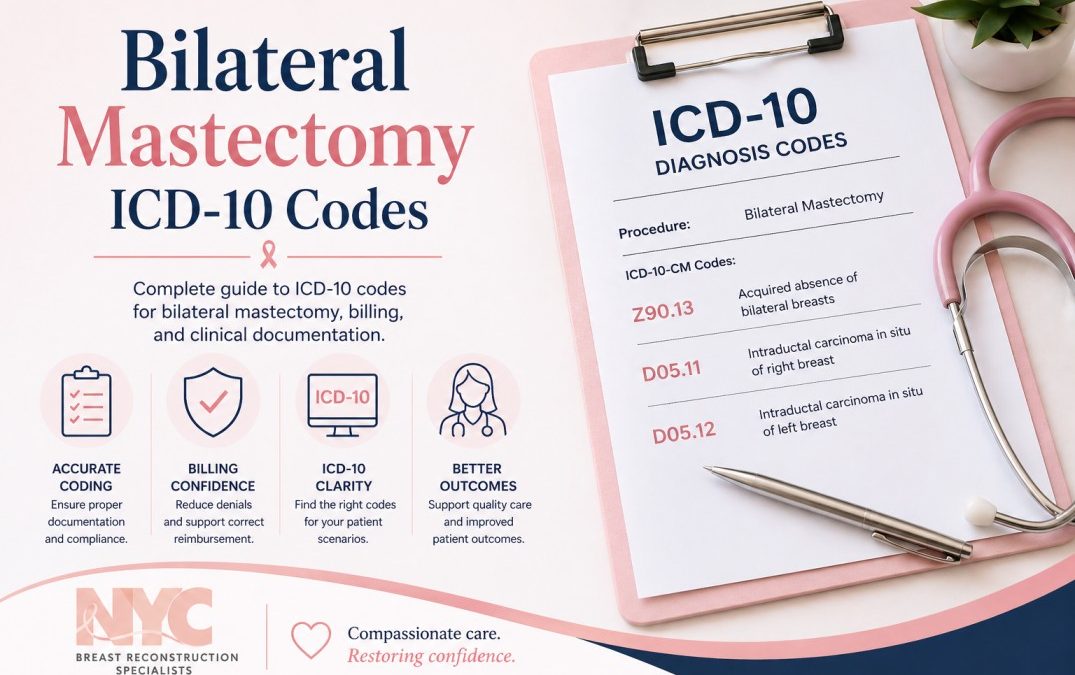
If you’re researching a bilateral mastectomy (whether as a patient, provider, or medical biller) you’ve likely come across the term ICD-10 code.And almost immediately, the confusion starts. Is there a specific ICD-10 code for bilateral mastectomy? Why are there multiple codes? And how do these codes actually impact insurance coverage and documentation?
This guide helps you answer some of these questions.
What Is the ICD-10 Code for Bilateral Mastectomy?
There isn’t a single ICD-10 code that directly represents a bilateral mastectomy.
Instead, ICD-10 codes are used to document the underlying condition that led to the surgery. The specific code depends on the patient’s diagnosis.
Examples of ICD-10 Codes Used
- Breast Cancer – C50.x (varies by location and laterality)
- Z40.01 – Encounter for prophylactic removal of breast
- Z85.3 – Personal history of malignant neoplasm of breast
These codes explain the clinical reason for the procedure.
How is Bilateral Mastectomy Documented?
The fact that the mastectomy is bilateral is captured through procedure coding (CPT) and modifiers, not through ICD-10.
Common ICD-10 Diagnosis Codes Related to Bilateral Mastectomy
Because ICD-10 codes describe the underlying condition, the exact code used will depend on the reason for the bilateral mastectomy.
Here are the most commonly used diagnosis codes:
Breast Cancer (Malignant Neoplasm)
- Breast Cancer – C50.x
- These codes vary based on the location of the tumor (e.g., upper outer quadrant, central portion)
- They also include laterality (left, right, or unspecified breast)
This is used when the mastectomy is performed to treat active breast cancer. In bilateral cases, separate ICD-10 diagnosis codes may be assigned for each breast when cancer is present on both sides.
Prophylactic (Preventive) Mastectomy
- Z40.01 – Encounter for prophylactic removal of breast
This code is used for patients at high risk (e.g., genetic predisposition) who elect to have a preventive bilateral mastectomy.
Personal History of Breast Cancer
- Z85.3 – Personal history of malignant neoplasm of breast
This ICD-10 code is used when the patient has had breast cancer in the past and is undergoing surgery for risk reduction or reconstruction planning.
Genetic Susceptibility (Optional Supporting Code)
- Z15.01 – Genetic susceptibility to malignant neoplasm of the breast
Often used alongside other codes for patients with BRCA mutations or similar risk factors.
CPT Codes for Bilateral Mastectomy (Procedure Codes)
CPT codes are used to document the actual mastectomy procedure, including whether it is performed on one breast or both.
Common CPT Codes for Mastectomy
The specific CPT code depends on the type of mastectomy performed:
- 19303 – Simple (total) mastectomy
- 19304 – Subcutaneous mastectomy
- 19305 – Radical mastectomy
- 19307 – Modified radical mastectomy
These codes describe the surgical technique, not whether the procedure is unilateral or bilateral.
How Is “Bilateral” Indicated?
A bilateral mastectomy is typically reported using:
- The appropriate CPT code with a modifier (commonly modifier -50 for bilateral procedures)
or - Reporting the code twice (depending on payer requirements)
This tells the insurer that the procedure was performed on both breasts, not just one.
When Is a Bilateral Mastectomy Medically Necessary?
A bilateral mastectomy is considered medically necessary when it is performed to treat disease or significantly reduce the risk of developing it.
Common Medical Indications
-
- Active breast cancer in one or both breasts
- High risk of developing Breast Cancer due to:
- BRCA1 or BRCA2 gene mutations
-
- Strong family history
- Cancer in one breast with increased risk in the opposite breast
- Recurrence of breast cancer
- Certain high-risk or aggressive tumor types
In these cases, removing both breasts may be recommended as part of a treatment or prevention strategy.
Does Insurance Cover Bilateral Mastectomy?
In many cases, yes. Insurance does cover bilateral mastectomy, but coverage depends on whether the procedure is considered medically necessary.
When Is It Covered?
Insurance providers are most likely to approve coverage when the surgery is performed to:
- Treat active breast cancer
- Reduce risk in patients with a high likelihood of developing Breast Cancer
- Address recurrence or complications related to prior cancer
When properly documented, these cases are typically eligible for coverage under most health plans.
When It May Not Be Covered
Coverage may be limited or denied if:
- The procedure is considered elective or cosmetic
- There is insufficient documentation of medical necessity
- The patient does not meet the insurer’s criteria for risk-reduction surgery
What About Reconstruction?
In the United States, if a mastectomy is covered, breast reconstruction is often covered as well, including procedures to improve symmetry.
Bilateral Mastectomy and Breast Reconstruction Coding
When a bilateral mastectomy is performed alongside or followed by breast reconstruction, both procedures must be coded accurately and separately. This is where coding becomes more detailed, as multiple codes are often required.
How Coding Works Together
- ICD-10 codes – describe the underlying diagnosis (e.g., cancer, high-risk status)
- CPT codes (mastectomy) – describe the removal of breast tissue
- CPT codes (reconstruction) – describe the rebuilding of the breast
Each part plays a role in documenting the full scope of care.
Common CPT Codes for Reconstruction
Depending on the reconstruction method, codes may include:
- 19340 / 19342 – Immediate or delayed insertion of breast implant
- 19357 – Tissue expander placement
- 19361 – Breast reconstruction with latissimus dorsi flap
- 19364 – Breast reconstruction with free flap (e.g., DIEP flap)
If the procedure is performed on both breasts, bilateral modifiers (e.g., -50) or dual coding may be used, depending on payer requirements.
How Medical Coding Impacts Insurance Approval
Medical coding plays a direct role in whether a bilateral mastectomy is approved, delayed, or denied by insurance.
Even when a procedure is medically appropriate, incorrect or incomplete coding can delay approval.
Why Coding Matters
Insurance companies rely on coding to determine:
- Medical necessity (based on ICD-10 diagnosis codes)
- Type of procedure performed (based on CPT codes)
- Whether the surgery meets their coverage criteria
If any part of this is unclear or inconsistent, the claim may be flagged or rejected.
Common Issues That Lead to Denials
- Mismatch between diagnosis (ICD-10) and procedure (CPT)
- Missing or incomplete supporting documentation
- Failure to indicate the procedure was bilateral
- Incorrect or missing modifiers
- Lack of evidence supporting medical necessity
How to Avoid Delays or Denials
To improve approval chances, providers typically:
- Ensure accurate and specific diagnosis coding
- Clearly document the clinical reason for surgery
- Use the correct CPT codes and modifiers
- Submit all required supporting records (imaging, pathology, genetic testing if applicable)
FAQs About Bilateral Mastectomy Coding
Is there a single ICD-10 code for bilateral mastectomy?
There is no single ICD-10 code for bilateral mastectomy. ICD-10 codes describe the underlying diagnosis, while the procedure itself is captured using CPT codes and modifiers.
How is “bilateral” indicated in medical coding?
“Bilateral” is typically indicated using CPT modifiers (such as -50) or by reporting the procedure code twice, depending on the payer’s requirements.
Do ICD-10 codes affect insurance coverage?
ICD-10 codes are used to establish medical necessity, which is a key factor in determining whether insurance will approve and cover the procedure.
Can the same ICD-10 code be used for both breasts?
In many cases, a single diagnosis code (e.g., for Breast Cancer) can apply to the overall condition, but additional specificity (such as laterality) may be required depending on the situation.
Are reconstruction procedures coded separately?
Breast reconstruction is coded separately using its own CPT codes, even when performed at the same time as the mastectomy.
Why are there so many different codes involved?
Because medical coding separates the diagnosis (ICD-10) from the procedure (CPT), multiple codes are needed to fully document the patient’s condition and the care provided.