
Many women who have gone through breast cancer and are considering reconstruction feel uncertain from the start.
How many procedures will I need? What happens first? How long does it all take? And when will I finally feel ‘done’?
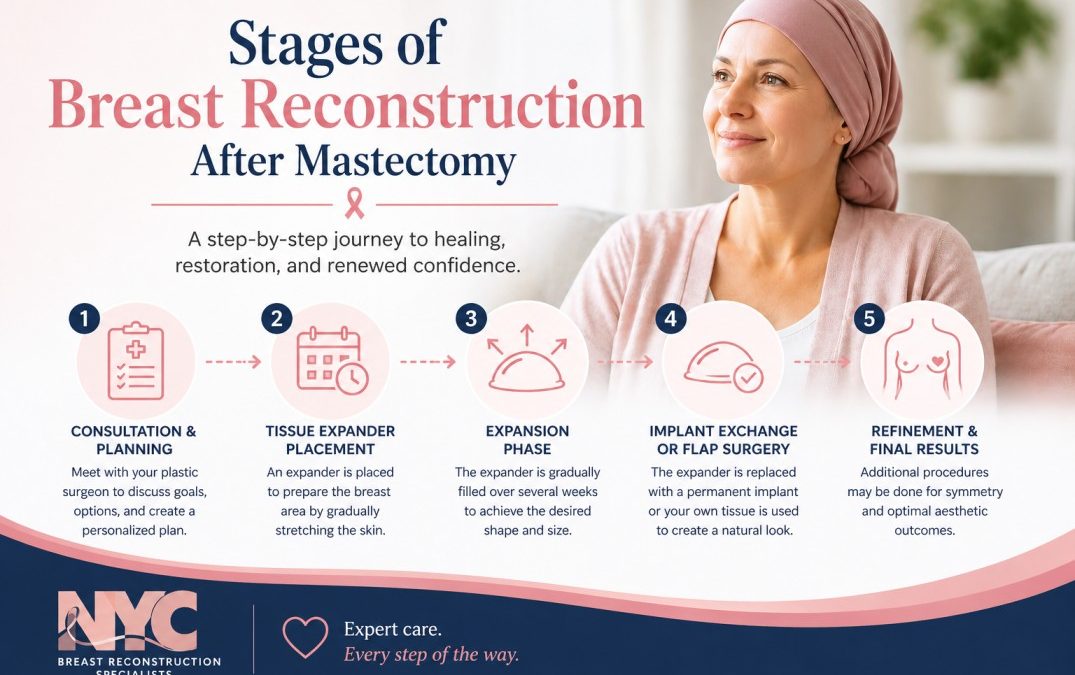
Breast reconstruction offers a path forward. But it’s important to understand that it’s usually not a single procedure. It’s often a step-by-step process, with each stage building toward a more complete, natural result.
Note: These stages don’t always occur in a strict order and may be combined or adjusted depending on your reconstruction plan.
What Are the Stages of Breast Reconstruction? (Quick Overview)
While every patient’s plan is different, most reconstruction journeys include the following stages:
- Stage 1: Initial Reconstruction
The first surgery creates the foundation of the breast using either implants or your own tissue (flap reconstruction). This may be done at the time of mastectomy (immediate) or later (delayed). - Stage 2: Tissue Expansion or Secondary Reconstruction
If implants are used, tissue expanders may be placed and gradually filled over time to prepare for the final implant. In other cases, this stage may involve additional procedures to refine the initial reconstruction. - Stage 3: Refinement and Symmetry Procedures
The breast is reshaped and adjusted for a more natural look. This may include fat grafting or surgery on the opposite breast to improve balance. - Stage 4: Nipple and Areola Reconstruction
The final stage focuses on recreating the nipple and areola, often through minor surgery or medical tattooing, to complete the overall appearance.
Stage 1 – Initial Breast Reconstruction Surgery
The first stage of breast reconstruction focuses on rebuilding the breast mound and creating the foundation for all future steps. This is the most significant part of the process and sets the direction for your overall results.
This stage can happen in two ways:
- Immediate reconstruction – performed at the same time as your mastectomy
- Delayed reconstruction – done months or years later, after other treatments like chemotherapy or radiation
During this procedure, your surgeon will use one of two main approaches:
- Implant-based reconstruction – a breast implant or tissue expander is placed to begin forming the breast shape
- Autologous (flap) reconstruction – tissue is taken from another part of your body (such as the abdomen or thighs) to create a natural breast mound
What to Expect After Stage 1
| Hospital stay | May range from same-day discharge to a few days, depending on the specifics of your treatment |
| Initial recovery | Typically 2-6 weeks for most daily activities |
| Swelling and tightness | Common in the early healing phase |
| Follow-up care | Regular check-ins with your surgeon to monitor healing and plan next steps |
Stage 2 – Tissue Expansion for Implant-Based Reconstruction
For patients who undergo implant-based reconstruction, the second stage focuses on gradually creating space for the final breast implant.
If a tissue expander was placed during Stage 1, it will be slowly filled with saline over time:
- The expander is gradually filled during office visits over several weeks
- This process gently stretches the skin and muscle to accommodate a permanent implant
- Once the desired size is reached, a second procedure (implant exchange) is performed to replace the expander with the final implant
This step-by-step approach allows your surgeon to fine-tune breast size, shape, and symmetry before placing the final implant.
Timeline and What to Expect
- Tissue expansion typically takes several weeks to a few months
- Expansion visits are quick, with mild pressure or tightness that resolves shortly after
- The implant exchange is usually a short outpatient procedure with a relatively quick recovery
Stage 3 – Refinement and Symmetry Procedures (If Needed)
After the initial reconstruction, some patients choose to undergo additional procedures to refine the shape and improve balance – but this stage is not required for everyone.
Many patients are satisfied after earlier stages, while others opt for further adjustments to enhance the final result.
When performed, this stage may include:
- Refining breast shape and contour for better projection and smoothness
- Fat grafting (transferring fat from another area of the body) to add volume or soften edges
- Symmetry procedures on the opposite breast, such as a lift, reduction, or augmentation
The goal is to create better harmony between both sides, based on your preferences.
What to Expect
- Typically performed as an outpatient procedure
- Shorter recovery time compared to earlier stages
- Results become more refined and natural-looking as swelling settles
Stage 4 – Nipple and Areola Reconstruction (Optional)
This step is optional, and not all patients choose to undergo it.
In most cases, nipple and areola reconstruction is performed after the breast has fully healed and settled. This allows for more accurate positioning and natural results. However, in select cases, parts of this stage may be performed earlier depending on the reconstruction approach.
There are two main options:
- Nipple reconstruction surgery – a small procedure using local tissue to create a raised nipple
- Areola reconstruction (tattooing) – medical tattooing is used to recreate color and detail, often with 3D techniques
Some patients choose tattooing alone without surgical nipple reconstruction.
Timing and Recovery
- Typically performed a few months after earlier stages
- Usually done in-office or as a minor outpatient procedure
- Minimal downtime with quick recovery
What to Expect at Each Stage of Recovery
Recovery from breast reconstruction happens in phases, with each stage becoming progressively easier to manage.
| Stage | Recovery Experience | Timeline | What to Expect |
| Stage 1: Initial Reconstruction | Most intensive | 2-6 weeks | Swelling, tightness, limited upper body movement, gradual return to light activities |
| Stage 2: Expansion | Moderate | Expansion process: several weeks to a few months; .implant exchange recovery: days to a few weeks | Temporary pressure from expansion, shorter downtime after implant exchange or revisions |
| Stage 3: Refinement & Symmetry | Mild | 1-3 weeks | Minor swelling or bruising, soreness if fat grafting is used, improved shape |
| Stage 4: Nipple & Areola Reconstruction | Minimal | Few days | Mild sensitivity, quick return to normal activities |
Do All Patients Go Through Every Stage?
Not every patient goes through every stage of breast reconstruction. The process is highly individualized, and your treatment plan will depend on your anatomy, medical history, and personal goals.
For example:
- Some patients choose direct-to-implant reconstruction, which skips the tissue expansion stage
- Others undergoing flap reconstruction may need no follow-up procedures
- Some patients opt not to have nipple reconstruction, choosing to stop after achieving their desired breast shape
Choosing the Right Surgeon for Multi-Stage Breast Reconstruction
Choosing the right surgeon is important to get the best outcome from your breast reconstruction procedure.
What to Look For
- Board certification in plastic surgery
- Extensive experience in breast reconstruction, especially complex and multi-stage cases
- Proven results with both implant-based and flap procedures
- A clear, step-by-step treatment plan tailored to your case
- Strong communication and a willingness to answer questions at every stage
Why Experience Matters
Experienced breast surgeons, like Dr. Tomer Avraham and other experts at Breast Reconstruction Specialists of NYC plan your entire breast reconstruction journey upfront, anticipate challenges and adjust along the way to deliver natural, balanced,and long-lasting results.
FAQs About Breast Reconstruction Stages
How many surgeries are typically involved?
Most patients undergo 1 to 4 procedures, depending on the type of reconstruction and desired outcome.
Is breast reconstruction painful?
Discomfort is expected, especially after the first stage, but it is typically well-managed with medication. Each subsequent stage tends to involve less pain and shorter recovery.
Can breast reconstruction fail?
Complications are possible, but serious issues are uncommon when performed by an experienced surgeon. Risks vary depending on the method used (implant vs flap), and your surgeon will monitor you closely throughout the process.
Will my reconstructed breasts look natural?
Modern techniques are designed to create natural-looking, balanced results. Final appearance improves over time, especially after refinement and nipple reconstruction stages.
How long should I wait between stages?
This varies, but most stages are spaced several weeks to a few months apart to allow proper healing before moving to the next step.
Can I stop after one stage?
Some patients choose to stop after the initial reconstruction if they are satisfied with the result. The process is flexible and tailored to your preferences.